
AI Patient Simulations Built for Your Program
Assign encounters, track performance, and review rubric-aligned assessments — integrated into your LMS and your curriculum.
How Programs Use Clintuition
From first-year courses to advanced residency rotations, Clintuition fits into the way you already teach.
Medical Schools & Residency Programs
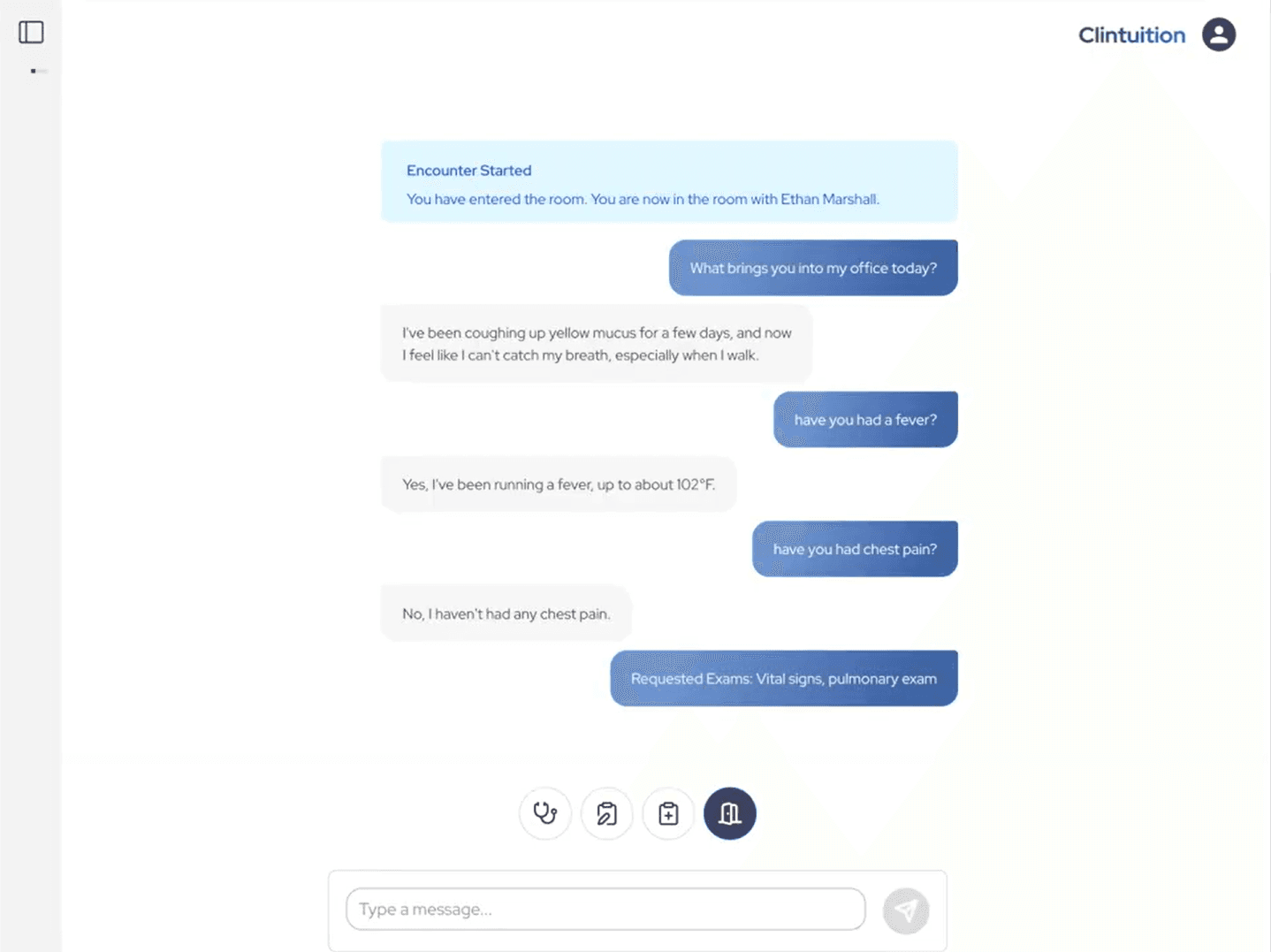
Give students and residents a safe space to practice history-taking, differential diagnosis, and clinical decision-making. Assign AI patient encounters as structured coursework and review rubric-aligned performance data to track learner progress across clinical domains.
- Assign encounters to individuals or entire cohorts
- Review detailed scoring across history, physical exam, and reasoning
- Track learner performance over time with longitudinal assessments
Nursing & Allied Health Programs
The same encounter and assessment engine supports nursing, pharmacy, PA, and allied health training scenarios. Convert case studies into conversation-based simulations that help trainees build clinical communication and care coordination skills.
- Customizable patient cases for any discipline
- Group-based assignment and instructor review workflows
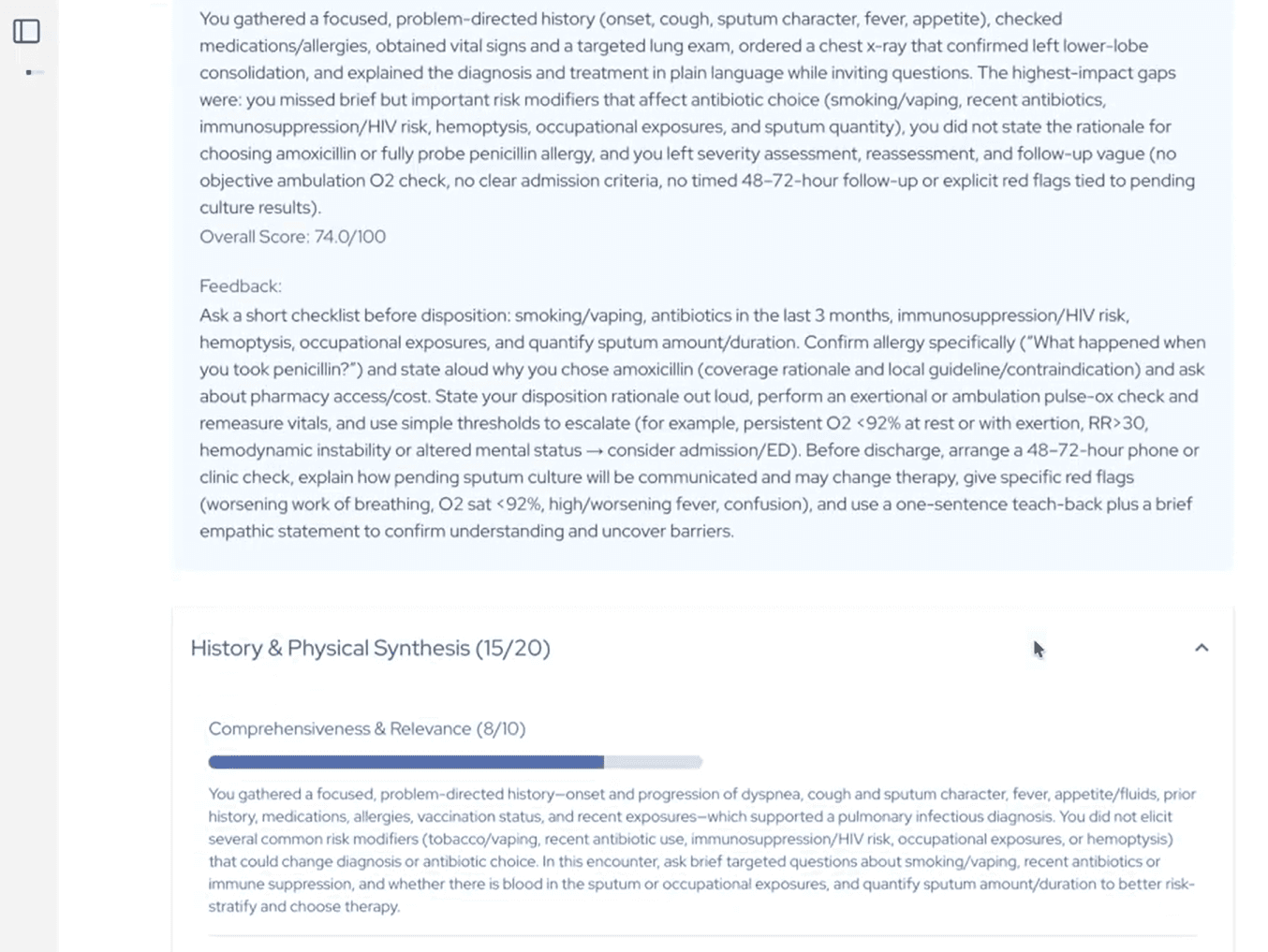
- Rubric-aligned AI assessment after every encounter, so learners get specific, structured feedback even when an instructor isn't available
OSCE & Standardized Patient Preparation
Learners can practice patient interactions on demand before high-stakes assessments. Each encounter focuses on the same core clinical skills evaluated in OSCEs — history-taking, physical exam technique, and differential diagnosis — with immediate, rubric-aligned feedback.
- Unlimited practice with realistic AI patients
- Immediate feedback after every encounter
- Builds confidence for live standardized patient exams
Faculty & Curriculum Development
Educators can author custom patient cases and rubrics with an AI co-author, define learning objectives, and assign to learner groups. Review encounter transcripts and assessment results to refine curricula with real data about where learners struggle.
- Patient Studio (AI-assisted) — co-author cases in conversation, or use the manual editor. Build a blind case for residency or OSCE programs — the AI writes it, the diagnosis stays hidden from your students.
- Rubric Studio (AI-assisted) — draft rubrics in conversation, edit by hand, attach to any case.
- Drafts stay private until you publish. Build cases over weeks if you need to, version-control your edits, and choose exactly when each case becomes available to a cohort.
- Assign specialty-specific cases to targeted cohorts.
- Use performance data to improve curriculum design.
Built for Educators, Not Just Learners
Clintuition gives you the tools to manage clinical simulations at scale — without the administrative overhead.
Cohort & Group Management
Organize learners into groups, assign patient encounters, and set whether instructor review is required before learners see their results.
LMS Integration
Launch simulations directly from Canvas, Moodle, or any LTI 1.3-compatible LMS — learners sign in once. LTI grade passback is in pilot now with select Canvas and Moodle programs.
Patient Studio (AI-Assisted)
Co-author cases by talking to an AI co-author, or use the manual editor for full control. Build a blind case for OSCE/residency programs — the AI writes it with the diagnosis hidden from author and learners alike.
Rubric Studio (AI-Assisted)
Draft assessment rubrics by talking to an AI co-author — domains, items, and scoring criteria built in conversation. Edit anything by hand. Attach to any case.
AI Assessment Engine
Every encounter generates a detailed narrative assessment with an overall score, specific gaps, and rubric-aligned feedback. Instructors can review transcripts, add comments, and require sign-off before learners see results.
Longitudinal Tracking
Track learner performance over time with longitudinal assessments that link educator evaluations across multiple encounters.
Bring Clintuition to Your Program
Create a free account to test encounter workflows, or contact us to discuss implementation in your curriculum.